
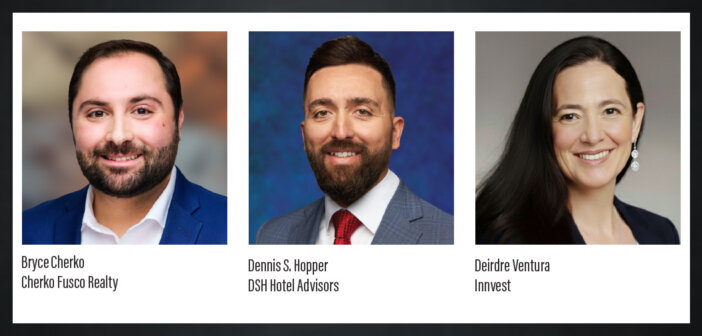
DSH Hotel Advisors’ Dennis Hopper is featured in Hotel Business’ Broker’s Report, “The Deal Landscape.” Access the full article via the link below.
Varying forces are shaping today’s hotel transaction market. Hotel Business spoke with Bryce Cherko, VP, sales and leasing, Cherko Fusco Realty; Dennis S. Hopper, managing principal/founder, DSH Hotel Advisors; and Deirdre Ventura, principal, Innvest, to talk about investor discipline, the types of assets drawing the strongest demand and what they expect for hotel investment activity in the year ahead.
—Gregg Wallis
What trends are shaping hotel transactions in today’s market?
Cherko: One of the biggest trends I’m seeing is a heightened level of discipline among investors. Groups are being selective about the types of assets they pursue. Most buyers have very clearly defined criteria—whether that’s specific brands, markets with strong demand drivers, deal size or targeted going-in yields.
Because transactions are harder to complete in today’s environment, investors are generally doing fewer deals than they might have several years ago. However, the deals they do pursue tend to be much more strategic. Overall, the market has shifted toward quality and selectivity over quantity, which I think reflects a more disciplined and mature investment approach.
Hopper: Several trends are driving hotel transactions today. Buyers are focused on assets with limited capital expenditure requirements and strong in-place cash flow, seeking stability and immediate performance. Midscale and upper-midscale limited-service properties remain especially popular due to their operating efficiency and broad buyer appeal. Since 2021, extended-stay hotels have also been a very popular segment for building and adding to hotel portfolios due to their operational efficiencies—especially when owning multiple extended-stay hotels within the same market.
Location has become increasingly important, with well-positioned assets standing out among the larger pool of hotels currently on the market. At the same time, seller pricing expectations have been slowly adjusting to buyer expectations, leading to increased transaction activity. Financing also remains readily available for qualified buyers acquiring cash-flowing assets, which continues to support deal volume.
Ventura: It’s always about perception. Seller’s perception is “I have realized my potential with this asset” and buyer’s perception is “I can take this asset to the next level.” Successful transactions are always based on linking people, opportunities and ideas that drive growth and transformation with insight and integrity. The facts in a transaction are always the same. How the facts are perceived—and the impact they have—often varies from each party’s perspective.
Seasoned parties are always more conservative and less optimistic about the future and younger, more savvy, better educated investors with more years ahead of them are aways more optimistic. It’s human nature. Equity never desires to sit on the sidelines. Equity needs to be working.
Which property types or markets are attracting the strongest investor demand?
Cherko: The markets attracting the most investor demand tend to be those with diverse and reliable demand drivers.
Investors are especially interested in markets anchored by institutions such as major universities, large healthcare systems, corporate headquarters, sports and entertainment venues or established leisure destinations. These types of demand drivers tend to create consistent year-round occupancy.
Markets that offer a balanced mix of business and leisure travel are particularly attractive because they provide more resilience across economic cycles. When one segment slows, the other can often help support performance.
Hopper: Right now, investor demand is strongest for midscale and upper-midscale select-service and extended-stay properties. These segments continue to perform well operationally and attract a broad buyer pool.
Buyers are especially focused on locations with multiple demand generators—markets supported by a mix of corporate, healthcare, education and leisure demand tend to provide more stability through cycles. There’s also a strong preference for assets with minimal capital expenditure requirements and revenues that are stabilized rather than in a downward trend.
Well-known flags continue to carry weight, particularly in today’s lending environment, and we’re seeing significant interest in high-barrier-to-entry markets where pricing is below replacement cost.
Ventura: Most investors acquire assets in markets they already understand. Markets that are close to home, with stable growth and limited or no new supply in the pipeline. Then the question becomes what is the investors defined “home” footprint? It could be as small as a two-hour radius of their existing assets or a multistate regional, national or international footprint. I have closed transactions with investors who already owns assets in Europe and California and New York City was desirable as it was in their defined “home” footprint.
From a property-type perspective, assets in the luxury and upscale select-service sector with strong producing brands underperforming the comp set (due to service issues rather than capital improvement needs) while offering the opportunity for the new owner to reduce expenses are the most desirable. The key to any transaction is unlocking the hidden asset value. Good brokers will uncover the hidden value and identify the buyer who recognizes the value and shares the perspective and has the resources to realize that hidden value.
How do you see the hotel investment landscape evolving for the rest of the year?
Cherko: I expect we’ll continue to see gradual improvement in pricing and transaction activity throughout the year. We’ve already started to see that on several deals as buyers and sellers slowly move closer together on expectations.
While operating costs are still rising faster than revenue in many markets, any decline in interest rates would certainly help support transaction pricing and deal flow.
That said, given the broader global and economic uncertainty, I would describe my outlook as cautiously optimistic. Investors will continue to transact, but the most sophisticated groups will remain highly disciplined, focusing on deals that clearly align with their investment strategy and can deliver strong long-term returns.
From a travel demand standpoint, the industry has experienced some normalization after the post-pandemic surge. While the next year may remain somewhat moderate, I’m optimistic that travel demand will continue strengthening over the longer term as consumer travel patterns stabilize.
Hopper: We believe the next few years will present one of the most compelling buying windows the hotel sector has seen in a decade—not from distress, but from pricing and market dynamics that can benefit both buyers and sellers. Many owners have been waiting for market improvements to consider a disposition. We are seeing those improvements slowly taking place now, and that will likely continue in coming months and years.
Transaction volume should increase meaningfully as investors take advantage of pricing that reflects compressed NOI and revenue levels, creating more attractive entry points than we’ve seen in recent years. At the same time, new hotel supply remains limited in many markets, which supports long-term performance fundamentals. Well-located midscale and upper-midscale flagged assets are particularly well positioned, and we anticipate that segment remaining the most active over the next several years.
Ventura: We expect more transactions in 2026 for a variety of reasons: 1) As an abundance of lower interest rate CMBS loans mature, many owners will elect to sell, especially if they are facing required PIP completions; 2) The slow and steady interest rate cuts and perceived future interest rate cuts spread optimism; 3) Host cities for the FIFA World Cup are excited and optimistic about the positive economic impact; 4) Private equity firms with excessive amounts of “dry powder” are shifting focus from other asset classes to hotels as hotels are currently perceived to be a better value offering higher returns; and 5) European hotel owners are seeking U.S. investment opportunities particularly in New York and internationally recognized markets in Florida. Current cap rates are much higher in New York than they are in Europe. This value opportunity is pushing equity across the pond for high quality assets.
By Gregg Wallis Hotel Business
To see content in magazine format, The deal landscape – HB To Go.