
Part 3 of 3 — Closing the Loop on the Mid-Market Opportunity
In Part 1 of this series, we mapped the transactional forces reshaping how midscale and upper midscale hotels are valued and traded. In Part 2, we examined how the best-run properties in this segment are building stronger, more durable margins through what we called the “Scale Without Size” advantage. Part 3 closes the loop – and introduces the two market forces that may end up defining the midscale opportunity more than any other factor heading into the back half of 2026 and beyond.
The Supply Story Very Few are Talking About
Most of the conversation around midscale hotel investment has focused on demand – who is buying, what flags are trading, and how cap rates are moving. But the supply side of the equation deserves equal attention, and the data is striking.
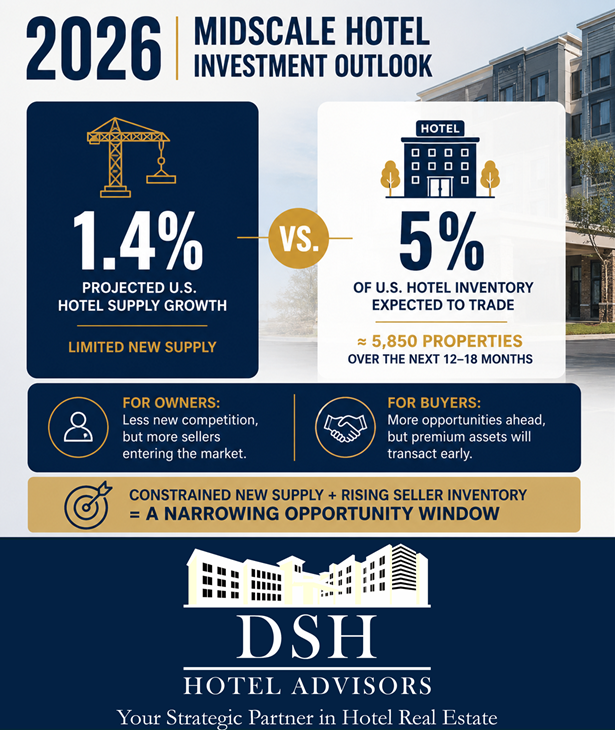
New hotel construction across the U.S. is projected to grow by just 1.4% in 2026 – a historically modest figure – the result of a prolonged period in which high construction costs and expensive debt caused a significant share of developers to delay or cancel new projects entirely. For owners of existing assets in stable markets, that constraint is a meaningful and underappreciated form of protection. Your property is not competing against a wave of new inventory. That is a genuine advantage, and it is one that supports valuation durability in ways that do not always show up in a trailing twelve-month NOI analysis.
However, the full supply picture has a second side that is equally important to understand. While new construction remains limited, an estimated 5% of total U.S. hotel inventory – roughly 5,850 properties – is expected to come to market over the next twelve to eighteen months, driven by the convergence of maturing CMBS debt, rising PIP compliance costs, and owners facing a refi-or-exit decision at materially higher interest rates. That figure does not yet fully account for the additional forced sales that the broader CMBS maturity wall is likely to generate on top of it.
For owners, this creates a clear and time-sensitive dynamic. You are not facing new-build competition eroding your market position – but you will increasingly be competing for buyer attention against a growing pool of sellers. The best-positioned assets – renovated, well-flagged, and operationally clean – will transact early in that cycle and at a premium. The ones that enter the market later, as inventory builds and buyers gain more options, will face a more crowded and more price-sensitive environment.
For buyers, this same dynamic reshapes the acquisition math. When new supply is constrained, the value of existing – particularly well-flagged, well-located midscale assets – holds more durably through market cycles. You are not underwriting against an anticipated wave of new competition. That is a materially different risk profile than what buyers faced during the post-COVID development boom, and it is one of the cleaner arguments for why this segment continues to attract institutional and private capital alike.
The Flag Premium Just Got a New Dimension
Sophisticated buyers in 2026 are beginning to underwrite something that did not appear in acquisition models even two years ago: AI discoverability as a component of flag value. As AI-driven travel search reshapes how guests find and book hotels – growing at roughly 50% faster than traditional search – the brands that have invested in structured content, loyalty ecosystems, and direct booking infrastructure are surfacing preferentially in that environment. This is not something an individual owner controls. It is built into the flag itself.
What this means at the transaction level is straightforward. Well-flagged midscale assets -particularly those under banners with high direct-booking ratios and strong brand content infrastructure – carry a discoverability advantage that will compound in value as AI search continues its adoption curve. For buyers evaluating two otherwise comparable assets, the flag’s position in this emerging distribution landscape is becoming a legitimate differentiator in long-term hold underwriting. For owners, it is one more reason why a performing flag is not just a revenue tool today – it is a component of exit value tomorrow.
The Bottom Line
The case for midscale and upper midscale has been built across all three parts of this series – in the transactional data, in the operating margins, in the supply dynamics, and now in the emerging valuation premium being assigned to assets whose flags are positioned for the next generation of how travelers search and book. Taken together, these forces describe a segment that is not simply weathering the current market – it is being actively rewarded by it.
What that reward looks like depends entirely on where you sit. For owners with well-positioned assets, it looks like genuine exit leverage in a window that will not stay open indefinitely as seller inventory builds. For buyers, it looks like a narrowing set of high-quality acquisition opportunities before that same inventory wave compresses the pricing advantage. For both, the most valuable next step is the same: an honest, current-market assessment of where your position stands and what it is actually worth right now.
That is the conversation our team is built for – whether you are a single-property owner exploring your options or an institutional buyer working through a portfolio-level strategy. We would be glad to be your starting point.
by Matt Lawrence
Director of Strategy and Development
DSH Hotel Advisors